Purpose
The “BARS” repeater extends the coverage of VHF radios
- in difficult, hard-to-reach terrain,
- where there is no equipment shelter or 220 V mains power,
- on tall masts, to shorten the antenna feeder cable.
Main specifications
| Frequency range | 146–174 MHz |
| Rx sensitivity | 0.2 µV for 12 dB S/N |
| Tx power | 6–8 W |
| Energy reserve | 400 h |
| Solar panel | 50 W, 17 V, 3.5 A |
| Operating temperature | -30 to +60 ºC |
| Telemetry | GMSK 1200 baud |
| Interface | RS-232 |
| Dimensions | 520×610×300 mm |
| Weight | 18 kg |

Advantages
Autonomy
- The repeater is fully autonomous and needs neither maintenance nor a shelter.
- It is powered by a solar panel and a battery.
- A thermal control system automatically keeps the optimum internal temperature over a wide range of outside temperatures.
Efficiency
- High-altitude siting and a directional antenna achieve coverage of around 200 km with low transmitter power and energy consumption.
Remote access
- Repeater settings — date, time, operating mode and battery charge control — can be changed remotely via the telemetry unit over the main radio channel.
- The telemetry receiver unit can be fitted to any subscriber station.
Self-diagnostics
- The repeater measures battery voltage, solar charging current and energy, and outside and inside temperature.
- This data and the current repeater settings are transmitted automatically once a day, or on request.
Compact
- The complete repeater with mast, antenna and solar panel weighs no more than 35 kg.
Installation
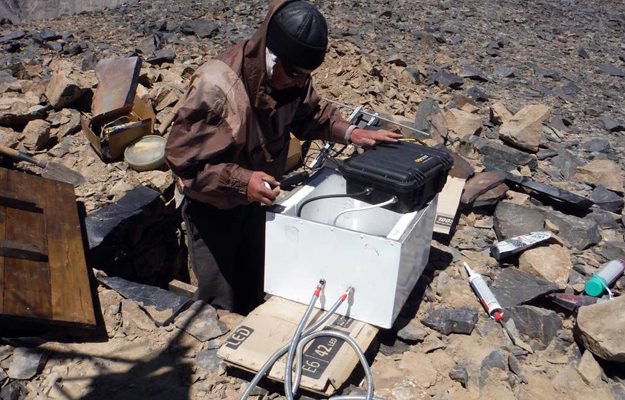
- No shelter is needed; the repeater can be installed in a trench next to the mast.