Initial design requirements for the collector
Easy to build. The collector can be made at home without special equipment, using simple tools found in almost every household. No particular skills are required.
Readily available materials. As much of the collector as possible should be made from materials salvaged free of charge from waste; the rest should be cheap to buy at the nearest shop or market. From the wide range of possible designs, we chose a model with a cylindrical reflector. It has a number of advantages that fully meet the initial requirements, but it is not normally used for home-made solar water heaters. Advantages of the cylindrical reflector design:
Material savings. Normally the heat-absorbing tubes in a collector run in parallel with the smallest possible gap. A reflector reduces the number of tubes by a factor of 2.5 for the same output.
Simpler construction. To retain heat, the tubes are normally placed in a sealed box insulated with foam and covered on one side with double glazing. Here there is no need for the box, foam or glass: a hollow tube of thin-walled clear plastic does all these jobs.
Effective thermal insulation. The air inside the plastic tube acts as the insulator.
Smaller heat-loss area. A conventional tube collector absorbs heat on one side only — the side facing the sun — but loses heat on both sides, front and back. In a collector with a reflector, both absorption and losses occur on both sides of the absorber tube. Unlike a parabolic reflector, a cylindrical one does not need to rotate to follow the sun.
Collector materials
The collector consists of an absorber tube (1) carrying the water to be heated, an insulating sleeve (2) that retains the heat gained from the sun, a reflector (3) that concentrates solar radiation onto the absorber tube (1), and a rigid frame (4) that keeps the structure stable and allows its angle to the sun to be adjusted.
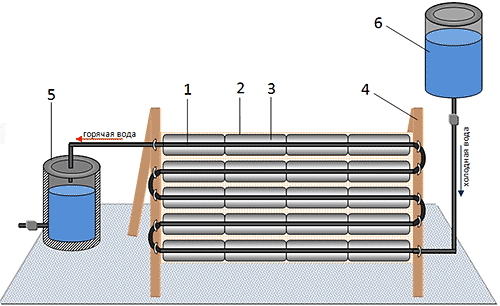
Absorber tube. It can be steel, copper, aluminium or plastic. Steel tube has acceptable thermal conductivity and is strong, durable and easy to obtain. Its main drawbacks are weight and cost. Copper tube has excellent thermal conductivity and is strong and durable. Copper would be ideal, but it is hard to find and very expensive. Aluminium tube has good thermal conductivity and is strong and light, but is unsuitable because it corrodes quickly in hot water. Plastic tube is inexpensive, strong, light, durable and easy to obtain. It is an excellent solution with one significant drawback: low thermal conductivity. We settled on a compromise: 12 mm metal-plastic (PEX-AL-PEX) pipe. It is cheap, readily available and strong, easy to work and bend, rigid enough, and all the fittings needed for joining and branching are available. Metal-plastic pipe is usually white, so it must be blackened to absorb solar radiation efficiently. The simplest option is to paint the pipe black, but paint adheres poorly to polyethylene, so the coating does not last. The second option is to smoke the pipe over the flame of a candle, kerosene lamp, etc. This gives a matt black coating that does not rub off. Each section of pipe must be held over the flame for a few seconds so the polyethylene surface softens slightly and the soot is absorbed into it. The method is ideal but slow and laborious. The third option is to wrap the pipe in a single layer of black insulating tape, turn against turn, applied with slight tension. This gives the required blackness and a strong, durable coating, although it slightly reduces the already low thermal conductivity of the metal-plastic pipe. Insulating sleeve A 1.5-litre plastic (PET) bottle was chosen. It is light, strong, weather-resistant, transmits light well and conducts heat poorly — and, of course, its main advantage is that it is free, since huge numbers of them lie discarded in the streets. Using them also helps, in a small way, to keep the streets clean and to address an environmental problem. The bottles must be transparent and colourless (blue, brown and similar bottles are unsuitable because they let through too little sunlight), preferably unscratched, rigid enough, and all of the same type so they can be joined into one long tube. Wash the outside of the bottles with detergent and simply rinse the inside several times with water. Cut off the bottom and neck so that what remains resembles a tube. The bottle tube must be dry before the reflective layer is applied.ReflectorIdeally, a shiny reflective layer would be applied directly to the bottle, but that requires special equipment. Aluminium foil is therefore used as the mirror. It is easy to work, readily available and has a fairly high reflectance. Rectangular sheets are cut from the foil and smoothed onto the surface of the plastic bottle to give them a concave shape. The foil is attached to the bottle with adhesive tape. A better option is self-adhesive reflective film applied to the inside of the bottle. The shiny surface is then protected from rain, wind and other weather. The reflector should cover half the circumference of the bottle. Rigid frame Made from 50 mm timber. The collector tubes are fixed to the frame with plastic or metal clamps, along with support legs that set the collector’s angle to the sun. Designing the collector: on a clear day, depending on latitude, about 1000 W of solar radiation falls on each 1 m2 of the Earth’s surface. A 1 kW collector would therefore need a total working surface of 1 m2. In reality, only about a third of the kilowatt falling on the collector reaches the user as hot water. The other two-thirds is reflected by the walls of the insulating sleeve, dissipated by the cold surrounding air, absorbed by the reflector and so on. In practice, then, a 1 kW collector needs an absorption area of about 3 m2. The absorption surface area is calculated as: Sa=l·d·N where l is the bottle length; d is the bottle diameter; N is the number of bottles in the collector. |